
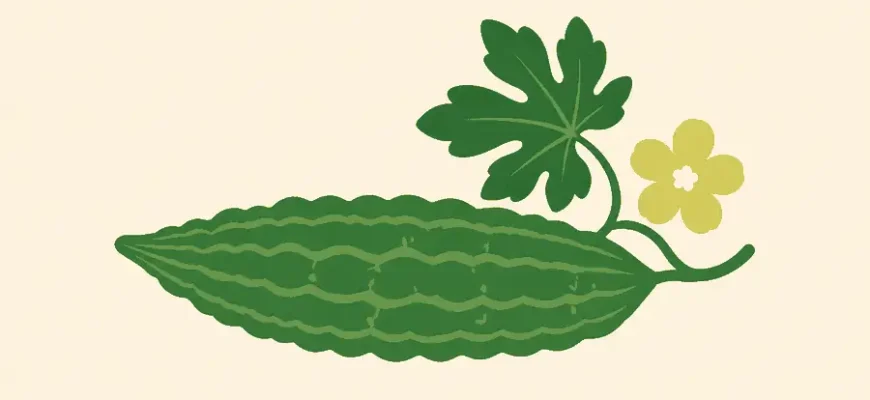
The bitter melon vs bitter gourd question usually has a simple answer: both names refer to Momordica charantia. Balsam pear, karela, ampalaya, and cerasee can also identify the same species. The preferred term changes by country, language, and product category.
The names may match botanically without making every product identical. Fresh fruit, dried fruit, powder, tea, capsules, and tinctures can contain different plant materials and preparations. HerbEra takes the editorial position that a common name should be checked against the scientific name, plant part, and format before products are compared.
- Are bitter melon, bitter gourd, and balsam pear the same plant?
- Why does one species have so many names?
- What botanical details confirm the ingredient?
- Family
- Growth form
- Plant part
- Does the name balsam pear ever create confusion?
- Are Chinese and Indian bitter melons different species?
- Chinese market type
- Indian market type
- How do food and supplement formats differ?
- What should you check on a bitter melon label?
- Bitter Melon Product Identity Checklist
- Match the scientific name
- Identify the plant part
- Separate variety from species
- Confirm the product format
- Read the other ingredients
- Compare serving units
- Locate batch details
- FAQ
- Are bitter melon and bitter gourd the same?
- Is balsam pear another name for bitter melon?
- Is karela the same as bitter gourd?
- What is ampalaya?
- Are Chinese and Indian bitter melons different plants?
- Which part of bitter melon is used in food?
- Is a bitter melon tincture equivalent to fresh bitter gourd?
- What is the best way to identify a bitter melon product?
- Glossary
- Conclusion
- Sources Used
Are bitter melon, bitter gourd, and balsam pear the same plant?
Yes, these three English names commonly refer to Momordica charantia, an annual climbing plant in the Cucurbitaceae family. This is the same botanical family that includes pumpkins, cucumbers, squash, and other gourds.
Bitter melon appears frequently on U.S. food and supplement labels. Bitter gourd is common in India, South Asia, and British English. Balsam pear occurs in horticultural references, older English texts, and some regional markets.
The name alone does not confirm the full identity of a commercial product. A precise comparison also checks the species, plant part, and preparation method.
| Common name | Typical context | Usual botanical reference |
|---|---|---|
| Bitter melon | U.S. retail, Asian grocery, supplement labels | Momordica charantia |
| Bitter gourd | India, South Asia, British English | Momordica charantia |
| Balsam pear | Horticultural and regional English | Usually Momordica charantia |
| Karela | Hindi and Indian food markets | Momordica charantia |
| Ampalaya | Philippines and Filipino communities | Momordica charantia |
| Cerasee or carasee | Caribbean usage | Momordica charantia |
Why does one species have so many names?
Common names develop through local languages, trade, migration, and culinary traditions. They are practical, but they do not follow one global naming system.
The word “melon” reflects one English naming tradition. The word “gourd” reflects another. Neither term changes the plant’s accepted scientific identity. Karela and ampalaya come from regional language use rather than botanical classification.
Retail category also affects the wording. A U.S. supplement bottle may say bitter melon, while an Indian grocery label may say bitter gourd or karela. A gardening database may list balsam pear. These labels can describe the same species from different cultural viewpoints.
What botanical details confirm the ingredient?
The strongest identity marker is the scientific name Momordica charantia. Momordica is the genus, and charantia identifies the species. The abbreviation “L.” may follow the name in botanical databases because Carl Linnaeus formally described the species.
Family
Momordica charantia belongs to Cucurbitaceae, commonly called the gourd family. Family membership helps place the plant within a broader botanical group, but it does not make different Cucurbitaceae species interchangeable.
Growth form
The plant grows as a climbing annual vine in tropical and subtropical regions. It produces tendrils, yellow flowers, and textured fruit. The immature fruit is generally green. As it matures, it turns yellow or orange and can split open to expose seeds surrounded by red pulp.
Plant part
Food products usually use the immature fruit. Botanical products may specify fruit, leaf, seed, or another aerial part. A label that says only “bitter melon” leaves an important detail unresolved because these parts are not the same raw material.
Does the name balsam pear ever create confusion?
Yes. Balsam pear is an established common name for Momordica charantia, but common names are less controlled than scientific names. The genus Momordica contains several species, and regional naming practices may overlap.
Do not identify a product from the words “balsam pear” alone when the label provides additional botanical information. Check whether it lists Momordica charantia. Also distinguish balsam pear from similar phrases such as balsam apple, which may be used inconsistently across references.
The scientific name resolves most of this ambiguity. A label that provides both the common name and full binomial gives readers a clearer identity than either term alone.
Are Chinese and Indian bitter melons different species?
No. The familiar Chinese and Indian market types are generally forms of Momordica charantia, not separate species. Their appearance differs because growers select cultivars for particular markets.
Chinese market type
Chinese-type fruit is often longer, broader, and lighter green. Its surface usually has smoother ridges or rounded bumps. The overall shape may look oblong.
Indian market type
Indian-type fruit is often shorter, narrower, and darker green. It commonly has pointed ends and a more sharply textured surface.
Shape and color can vary among cultivars. Visual differences therefore help describe a market type, but they do not replace the botanical name.
How do food and supplement formats differ?
Products can share the name bitter melon while containing substantially different materials. Whole fruit retains the physical structure of the food. Powder usually contains dried and milled plant material. A tincture is a liquid extract made with a stated carrier or solvent system.
For a format-specific retail example, HerbEra presents this Bitter Melon tincture as a liquid botanical product. Its common name identifies the plant, while the liquid format must still be evaluated separately from fresh fruit, dried slices, tea, or powder.
| Format | Typical material | Key label detail |
|---|---|---|
| Fresh vegetable | Immature fruit | Variety, origin, and physical condition |
| Dried slices | Dehydrated plant material, often fruit | Plant part and added ingredients |
| Powder | Milled dried material | Species, plant part, and serving weight |
| Tea product | Cut plant material or a blend | Ingredient list and plant part |
| Capsule | Powder or extract | Extract status, amount, and other ingredients |
| Tincture | Liquid botanical extract | Plant part, carrier, serving unit, and extract information |
Nutrition data for fresh or cooked bitter melon cannot automatically describe a tincture or concentrated extract. Processing changes what remains in the finished format. Only the product label and suitable analytical information can establish its declared composition.
What should you check on a bitter melon label?
Start with the back panel rather than relying on the front name. A useful label identifies the botanical, plant part, amount or serving unit, and other ingredients. Liquid products should also make their carrier clear.
Imported foods may use karela, bitter gourd, or another regional name without featuring “bitter melon.” That difference is not a warning sign by itself. Match the scientific identity and format before deciding whether two listings describe comparable products.
Batch or lot information adds traceability. A manufacturer may also provide origin, extraction details, or quality documentation. These details do not make unlike formats equivalent, but they make the comparison more specific.
Bitter Melon Product Identity Checklist
Use this checklist when two labels appear to describe different ingredients. It separates regional naming from differences that can change the actual product.
Match the scientific name
Look for Momordica charantia. Do not rely entirely on a common name when the botanical name is available.
Identify the plant part
Confirm whether the product uses fruit, leaf, seed, or another part. Products made from different parts should not be grouped automatically.
Separate variety from species
Differences in color, size, ridges, or shape may indicate a cultivar or market type. They do not necessarily indicate a different species.
Confirm the product format
Distinguish fresh food, dried material, powder, tea, capsule, oil, and liquid extract. Each format needs its own label-level comparison.
Read the other ingredients
Check for carriers, capsule materials, flavorings, or blended botanicals. The front-panel plant name does not describe the entire formula.
Compare serving units
Do not compare drops, milliliters, capsules, teaspoons, and grams as though they were equal units. Record the declared amount and its unit.
Locate batch details
Look for a lot number, expiration information, and available quality documentation. These details help connect the label to a specific production batch.
FAQ
Are bitter melon and bitter gourd the same?
Yes. Both names usually refer to Momordica charantia. Regional English preferences account for most of the naming difference.
Is balsam pear another name for bitter melon?
Yes, balsam pear is a recognized common name for Momordica charantia. Check the botanical name because common-name usage can vary.
Is karela the same as bitter gourd?
Yes. Karela is a widely used Indian name for Momordica charantia, the plant commonly called bitter gourd or bitter melon in English.
What is ampalaya?
Ampalaya is the Filipino name commonly used for Momordica charantia. It does not identify a separate botanical species.
Are Chinese and Indian bitter melons different plants?
They are generally different market types or cultivars of the same species. Their size, color, surface, and shape often differ.
Which part of bitter melon is used in food?
The immature green fruit is the main culinary part. Other plant parts may appear in separately labeled botanical preparations.
Is a bitter melon tincture equivalent to fresh bitter gourd?
No direct equivalence should be assumed. One is a liquid extract, while the other is a whole food with a different physical composition.
What is the best way to identify a bitter melon product?
Confirm the scientific name, plant part, product format, serving unit, carrier, and other ingredients shown on the label.
Glossary
Botanical name
A standardized scientific name consisting of a genus and species.
Common name
An everyday plant name that can vary by language, country, or market.
Momordica charantia
The accepted scientific name for bitter melon, bitter gourd, and balsam pear.
Cucurbitaceae
The botanical family that includes bitter melon, squash, cucumber, and pumpkin.
Cultivar
A cultivated plant selection with recognizable traits such as shape or color.
Plant part
The specific material used in a product, such as fruit, leaf, or seed.
Tincture
A liquid preparation produced by extracting botanical material into a carrier system.
Carrier
The liquid base that holds the extracted material in a finished liquid product.
Serving unit
The measurement used on a label, such as milliliters, drops, capsules, or grams.
Conclusion
Bitter melon, bitter gourd, and balsam pear usually name the same species, Momordica charantia. Compare the botanical name, plant part, and format to determine whether two products are genuinely alike.
Sources Used
- Accepted taxonomy, botanical family, distribution, and common names, Kew Plants of the World Online – powo.science.kew.org/taxon/urn:lsid:ipni.org:names:293413-1/general-information
- Regional names and species profile, NC State Extension Gardener Plant Toolbox – plants.ces.ncsu.edu/plants/momordica-charantia
- Indian commodity name, karela terminology, and botanical identity, eNAM Bitter Gourd Commodity Standard – enam.gov.in/web/docs/221_commodity_list.pdf
- Indian botanical identity and traditional naming, PCIM and H Monograph – portal.pcimh.gov.in/product_details/992e3ad4-950b-474b-943f-418940900792
- Chinese and Indian bitter melon market types, University of Florida IFAS Extension – edis.ifas.ufl.edu/publication/HS1271
- Botanical supplement labeling principles, FDA Dietary Supplement Labeling Guide – fda.gov/food/dietary-supplements-guidance-documents-regulatory-information/dietary-supplement-labeling-guide-chapter-iv-nutrition-labeling
- Definitions of botanical extracts and tinctures, NIH Office of Dietary Supplements Botanical Background – ods.od.nih.gov/factsheets/botanicalbackground-consumer