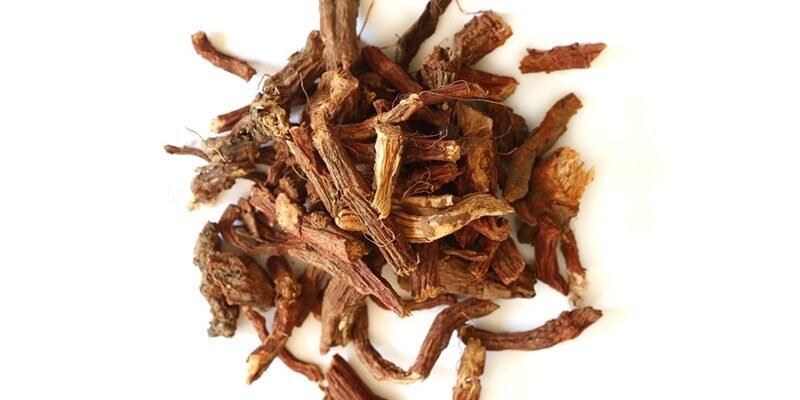
A red sage vs garlic supplement comparison starts with identity, not a claim that the two products serve the same purpose. Red Sage usually refers to Salvia miltiorrhiza, while garlic supplements usually contain Allium sativum. Garden Organics takes the useful editorial position that standardization is a product-specific specification, not a shared score that makes unrelated botanicals interchangeable.
This guide shows how to compare the declared species, plant part, preparation, marker compounds, serving amount, and supporting documents. It does not rank the ingredients or assess individual use.
- Are Red Sage and garlic supplements botanically related?
- What does standardization mean on a botanical label?
- Marker compound versus active ingredient
- Batch consistency versus product equivalence
- How is Red Sage commonly identified and standardized?
- Why do garlic supplements use different marker systems?
- Garlic powder and allicin potential
- Aged garlic extract and S-allyl-L-cysteine
- Garlic oil and oil-soluble compounds
- Which label details make the comparison transparent?
- Can research on one preparation support another format?
- Botanical Label Comparison Checklist
- Confirm the species
- Record the plant part
- Identify the preparation
- Find the marker specification
- Check the serving basis
- Clarify extract math
- Match the research material
- FAQ
- Are Red Sage and garlic the same botanical?
- Which plant parts are used in Red Sage and garlic supplements?
- What are common Red Sage marker compounds?
- What does standardized garlic mean?
- Are alliin and allicin the same compound?
- Does standardized mean that two supplements are equivalent?
- Can marker percentages be compared directly?
- Is an extract amount the same as a marker amount?
- Glossary
- Conclusion
- Sources Used
Are Red Sage and garlic supplements botanically related?
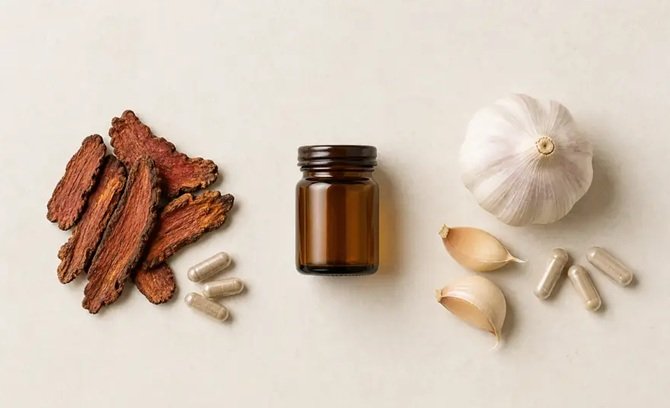
No. They come from different genera and botanical families. Red Sage in this context is Salvia miltiorrhiza Bunge, a member of the Lamiaceae family. Garlic is Allium sativum L., a member of the Amaryllidaceae family.
The source material also differs. Red Sage preparations generally use the root and rhizome. Garlic products use the bulb, commonly described as the bulb or clove on retail labels. A comparison that omits these plant parts misses a basic identity check.
| Comparison point | Red Sage supplement | Garlic supplement |
|---|---|---|
| Typical species | Salvia miltiorrhiza Bunge | Allium sativum L. |
| Botanical family | Lamiaceae | Amaryllidaceae |
| Common source part | Root and rhizome | Bulb or clove |
| Common formats | Powder, dry extract, capsule, or liquid extract | Powder, dry extract, aged extract, oil, tablet, or capsule |
| Example marker compounds | Salvianolic acid B and tanshinone IIA | Alliin, allicin potential, or S-allyl-L-cysteine, depending on preparation |
| Main label question | Does the label confirm species, plant part, and preparation? | Which garlic preparation and marker system does the label declare? |
What does standardization mean on a botanical label?
Standardization usually means that a manufacturer measures selected chemical markers to keep batches consistent. A marker can help identify or control an extract. It does not represent the entire plant or make unrelated botanicals comparable.
In the United States, botanical supplements are not required to be standardized, and the term has no legal or regulatory definition. Rules differ across markets. Look for the marker name, amount or percentage, reference material, and serving basis.
Marker compound versus active ingredient
A marker supports identification, measurement, or manufacturing control. It is not necessarily the sole compound relevant to the preparation.
Batch consistency versus product equivalence
A consistent marker level can support batch-to-batch control. It cannot make Red Sage and garlic extracts equivalent.
How is Red Sage commonly identified and standardized?
A strong Red Sage specification begins with Salvia miltiorrhiza and the root or rhizome. The common name is insufficient because unrelated plants can use names that include red sage or sage.
Analytical references discuss water-soluble salvianolic acids and lipophilic tanshinones. Salvianolic acid B and tanshinone IIA are examples used in identity or content specifications.
Those markers do not create a universal retail standard. Products may contain ground root, standardized dry extract, or an extract with no declared marker. Solvent, extract ratio, and carrier affect the finished ingredient.
The European Medicines Agency assessed Red Sage root and rhizome but did not adopt a European Union herbal monograph. Its assessment is not a universal retail specification.
Why do garlic supplements use different marker systems?
Garlic chemistry changes during crushing, drying, aging, extraction, and oil production. Identify the preparation before comparing label numbers.
Garlic powder and allicin potential
Intact garlic keeps alliin and the enzyme alliinase apart. Tissue disruption lets alliinase start reactions that form allicin. Because allicin is reactive and unstable, powder labels may declare alliin, alliinase activity, or allicin potential.
Allicin potential is a capacity measured or calculated under stated conditions. It is not the same as alliin content or stored allicin.
Aged garlic extract and S-allyl-L-cysteine
Aged garlic extract differs from garlic powder. S-allyl-L-cysteine, or SAC, is a stable, water-soluble marker used for some aged preparations. Its value is not numerically comparable with a Red Sage salvianolic acid or tanshinone specification.
Garlic oil and oil-soluble compounds
Garlic oils contain a different profile that includes oil-soluble organosulfur compounds such as diallyl sulfides. They are not equivalent to powder or aged extract. Odorless and enteric-coated describe product features, not marker amounts.
Which label details make the comparison transparent?
A useful label identifies the ingredient, preparation, and serving amount. A percentage without a named reference basis remains incomplete.
| Label statement | What it establishes | What still needs verification |
|---|---|---|
| Latin binomial and plant part | Botanical identity and source tissue | Authentication method and batch result |
| Herb powder, extract, aged extract, or oil | Basic preparation category | Process details, solvent, and concentration |
| Extract ratio or native extract amount | Relationship between source material and extract | Whether carriers are included |
| Named marker with amount or percentage | Declared target for a specific compound | Test method and batch result |
| Milligrams per serving | Quantity supplied by the labeled serving | Whether it refers to raw material or extract |
| Third-party test or certificate | Batch-specific documentation | Scope, laboratory, lot, and date |
A standards-focused article can compare garlic extract labels with this Gardenix botanical product without presenting the ingredients as substitutes. The physical Supplement Facts panel should confirm the Latin name, plant part, amount per serving, and whether the material is powder or extract.
Garden Organics would record a missing field as an unresolved label question, not evidence that the feature is absent. This avoids filling gaps with assumptions.
Can research on one preparation support another format?
Not automatically. The species and plant part must align first. Then compare preparation, extraction solvent, extract ratio, marker profile, amount, and delivery format.
A study of aged garlic extract standardized to SAC does not describe garlic oil or powder defined by allicin potential. A specified Red Sage root extract does not automatically match unspecified powder.
Also check whether the research used one ingredient or a blend. Results from a blend cannot be assigned to one component without separate evidence.
Botanical Label Comparison Checklist
Use this checklist before comparing product listings or research. Complete it from the physical label and current documents, not the front panel alone.
Confirm the species
Record the full Latin binomial. Do not assume that a shared or familiar common name identifies the exact plant.
Record the plant part
Look for root, rhizome, bulb, clove, leaf, or another stated tissue. Plant parts can have different chemical profiles.
Identify the preparation
Separate whole powder, dry extract, aged extract, tincture, and oil. Do not merge their composition data.
Find the marker specification
Record the marker, amount or percentage, and unit. Standardized without these details has limited value.
Check the serving basis
Confirm whether the quantity applies per unit or full serving. Note the units in that serving.
Clarify extract math
Check the extract ratio, native extract amount, and any botanical-equivalent claim. These figures answer different questions and should not be combined.
Match the research material
Match species, plant part, preparation, marker, and amount. If a key field differs or is absent, record uncertainty.
FAQ
Are Red Sage and garlic the same botanical?
No. Red Sage is usually Salvia miltiorrhiza from the Lamiaceae family. Garlic is Allium sativum from the Amaryllidaceae family.
Which plant parts are used in Red Sage and garlic supplements?
Red Sage products commonly use root and rhizome. Garlic supplements commonly use material derived from the bulb or clove.
What are common Red Sage marker compounds?
Salvianolic acid B and tanshinone IIA are commonly referenced analytical markers. Their presence on one specification does not define every Red Sage product.
What does standardized garlic mean?
It means the manufacturer has selected a measurable specification, such as alliin, allicin potential, or SAC. The exact marker depends on the garlic preparation.
Are alliin and allicin the same compound?
No. Alliin is a precursor in intact garlic. Enzymatic reactions after tissue disruption can lead to allicin formation.
Does standardized mean that two supplements are equivalent?
No. Standardization can support batch consistency for one product. It does not make different species, plant parts, extracts, or marker systems equivalent.
Can marker percentages be compared directly?
Only when the same compound, units, material basis, and test context are used. Percentages for unrelated compounds do not create a meaningful ranking.
Is an extract amount the same as a marker amount?
No. Extract amount is the weight of the prepared botanical ingredient. Marker amount is the measured quantity of one specified compound within it.
Glossary
Botanical identity
The verified genus and species of a plant ingredient.
Plant part
The source tissue used, such as root, rhizome, bulb, or leaf.
Standardization
A process used to keep selected measured characteristics similar across batches.
Marker compound
A chemical measured for identification or manufacturing control.
Extract ratio
The stated relationship between starting botanical material and resulting extract.
Allicin potential
The capacity of a garlic preparation to form allicin under specified conditions.
S-allyl-L-cysteine
A stable, water-soluble sulfur compound used as a marker in some aged garlic extracts.
Certificate of analysis
A document reporting test results and specifications for a particular batch.
Conclusion
A sound red sage vs garlic supplement comparison checks species, plant part, preparation, marker, and serving basis separately. Standardization improves comparability only when the label explains exactly what was measured.
Sources Used
Botanical classification and accepted name, Salvia miltiorrhiza – powo.science.kew.org/taxon/urn:lsid:ipni.org:names:456707-1
Botanical classification and accepted name, Allium sativum – powo.science.kew.org/taxon/urn:lsid:ipni.org:names:528796-1
European assessment record, Red Sage root and rhizome – ema.europa.eu/en/medicines/herbal/salviae-miltiorrhizae-radix-et-rhizoma
European herbal materials, Garlic bulb – ema.europa.eu/en/medicines/herbal/allii-sativi-bulbus
Consumer fact sheet, Botanical supplement forms and standardization – ods.od.nih.gov/factsheets/BotanicalBackground-Consumer
Regulatory labeling guide, Botanical plant parts in Supplement Facts – fda.gov/food/dietary-supplements-guidance-documents-regulatory-information/dietary-supplement-labeling-guide-chapter-iv-nutrition-labeling
Research paper, Garlic powder and allicin formation – pubmed.ncbi.nlm.nih.gov/29937536
Retail listing, Capsule-format product example – gardenix.com/products/red-sage-capsules